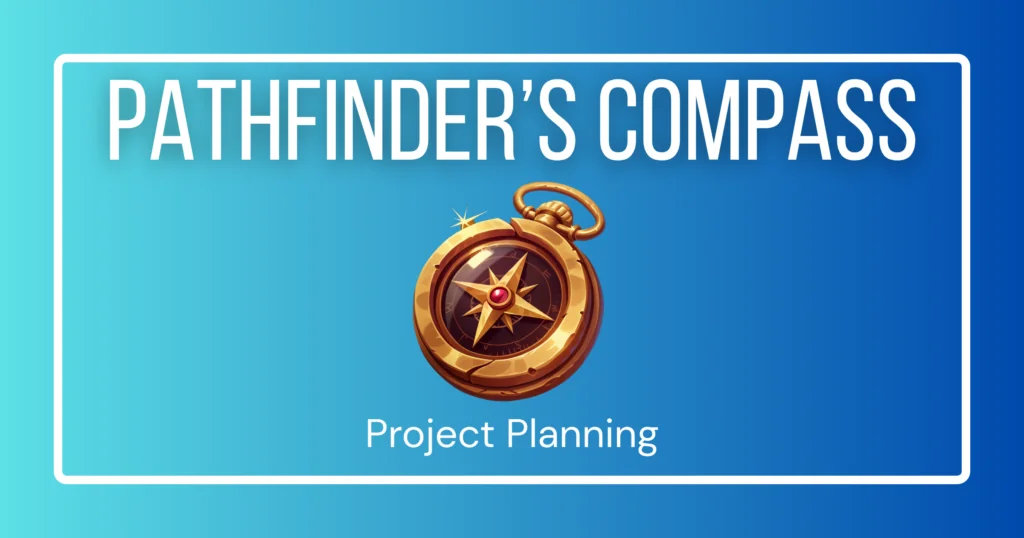

⚡ Quick Cast: Chart the optimal path through complex endeavors by breaking insurmountable quests into navigable waypoints with clear routes.
📋 Type: Technique
💰 Cost: 6 minutes
🎯 Best For: Project Planning
✨ Rarity: Uncommon
📖 Summary
The Barrens expedition nearly collapsed before it began. Two dozen guild members, supplies for a month, competing objectives, and a territory no scout had mapped—chaos threatened before we’d taken a single step. It was Hunter Mentor Sylva who saved us. “You’re looking at the entire wilderness at once, when you should be plotting a journey of distinct landmarks,” she observed, unfolding a strange device of brass and crystal. “This compass doesn’t point north—it reveals the nearest viable path between your current position and your ultimate destination.”
Under her guidance, an impossible expedition transformed into a sequence of achievable milestones. I’ve since learned that the most daunting quests rarely fail due to danger or difficulty, but because adventurers cannot see how to break the journey into manageable segments. The Pathfinder’s Compass technique is:
✅ Perfect for:
|
❌ Challenging for:
|
📜 Lore
Project planning methodologies have ancient origins—from the Roman aqueduct builders who developed staged construction techniques to the master cathedral architects of the Middle Ages who planned work spanning generations. Modern approaches emerged with the Gantt chart in the early 20th century, followed by critical path method (CPM) and program evaluation and review technique (PERT) developed for complex military and aerospace programs.
Today’s most effective project planning combines rigid structure with agile adaptability. The Pathfinder’s Compass represents this balance—systematic yet flexible—ensuring that even the most daunting endeavors can be broken into clear, navigable segments without sacrificing adaptability to changing conditions.
🗝️ Fundamentals
The Pathfinder’s Compass operates on several powerful principles of expedition magic:
The Waypoint Principle 🧭
Complex journeys become manageable when broken into distinct milestones. By establishing clear, achievable waypoints, you transform overwhelming projects into a series of conquerable challenges with visible progress markers.
The Critical Path Illumination ⚡
Not all tasks are equally important to project completion. The compass reveals which activities directly impact your timeline (the critical path) versus those with flexibility (float), allowing optimal resource allocation.
The Adaptation Protocol 🌊
No plan survives first contact with reality unchanged. Effective project planning includes built-in mechanisms for course correction, ensuring that unexpected obstacles become navigation data rather than expedition-ending barriers.
Common Misconceptions ❌
- “Detailed planning limits flexibility” – False. Proper planning creates a framework for informed adaptation rather than rigid adherence.
- “Simple projects don’t need planning” – Actually, even straightforward endeavors benefit from basic waypoint mapping to prevent scope creep and resource waste.
- “Planning is just making a to-do list” – Project planning involves understanding dependencies, resource allocation, and timeline management—a fundamentally different skill from simple task listing.
🛠️ Execution
🌱 Apprentice Level (Getting Started)
- Define your expedition objective in specific, measurable terms
- Conduct terrain mapping—identify all major components of the project
- Establish clear waypoints—key milestones that mark significant progress
- Determine task dependencies—what must happen before other elements can proceed
- Create a timeline estimate with reasonable buffers
- Assign resources and responsibilities for each segment
🔥 Journeyman Level (Mastering Basics)
- Identify the critical path of essential tasks
- Build in contingency routes for high-risk segments
- Develop progress tracking mechanisms with clear metrics
- Create communication protocols for team coordination
- Implement regular scouting reviews to assess and adjust
💎 Master Level (Advanced Techniques)
- Master resource leveling across multiple project streams
- Develop predictive risk assessment protocols
- Create adaptive planning systems that evolve with new information
- Implement stakeholder management strategies for complex endeavors
- Design interlocking project ecosystems for portfolio management
Challenges & Solutions
🧟♂️ Enemy: The Scope Creeper
Challenge: Project boundaries continuously expanding beyond control
Strategy: Create a formal change management process that evaluates all additions against the core expedition objective
🏜️ Enemy: The Timeline Mirage
Challenge: Consistently underestimating time and resource requirements
Strategy: Use the “multiply by pi” technique—take your initial estimate and multiply by 3.14 for a more realistic projection
👻 Enemy: The Resource Specter
Challenge: Hidden dependencies that cause unexpected delays and resource shortages
Strategy: Create comprehensive dependency maps with multiple review passes, soliciting input from diverse team members
🌟 Class Tactics
🏹 Hunter’s Practice
A Hunter in our guild transformed the Pathfinder’s Compass into a terrain mapping system. Their approach focused on thoroughly scouting the project landscape before charting a course. By identifying potential hazards, resource caches, and alternative routes in advance, their reconnaissance-based planning ensured they were never caught unprepared by changing conditions. This methodical groundwork created expeditions that were both ambitious and remarkably resilient.
📋 Tactical Summary
- Focus Style: Observational and terrain-aware
- Natural Advantage: Exceptional environmental analysis
- Primary Challenge: Balancing preparation with action
- Victory Condition: Navigating complex projects with minimal surprises
📖 The Summoner’s Method
A Summoner in our ranks approached the Pathfinder’s Compass as a systems analysis tool. They excelled at breaking complex projects into their component parts and understanding the intricate relationships between elements. Their analytical approach created comprehensive project architectures that revealed non-obvious critical paths and optimization opportunities. This method proved particularly effective for technically complex endeavors with multiple interdependent systems.
📋 Tactical Summary
- Focus Style: Systematic and analytical
- Natural Advantage: Identifying complex dependencies
- Primary Challenge: Potential analysis paralysis
- Victory Condition: Creating optimal project architectures
🗡️ Rogue’s Way
A Rogue in our circle adapted the Pathfinder’s Compass into an opportunity mapping framework. Rather than rigid plans, they created flexible project structures with multiple potential paths. Their adaptable approach emphasized maintaining agility while still having clear direction. This method enabled them to capitalize on emerging opportunities and navigate around obstacles without losing sight of the ultimate objective—perfect for projects in dynamic environments.
📋 Tactical Summary
- Focus Style: Opportunistic and flexible
- Natural Advantage: Adapting quickly to changing conditions
- Primary Challenge: Maintaining focus on core objectives
- Victory Condition: Successfully navigating dynamic environments
📖 Quest Log
Bronze Challenges ⭐
Difficulty: Beginner
[ ] Create a complete project plan for a personal endeavor
[ ] Identify and map all major dependencies in a current project
[ ] Successfully break a complex task into 5-7 distinct waypoints
[ ] Estimate time requirements for each project segment
[ ] Track actual vs. estimated progress through a complete project
Silver Challenges ⭐⭐
Difficulty: Intermediate
[ ] Identify the critical path in a multi-person project
[ ] Create contingency plans for high-risk project segments
[ ] Implement a regular project review and adjustment system
[ ] Successfully manage a project with at least 3 distinct phases
[ ] Create and use a resource allocation plan across project stages
Gold Challenges ⭐⭐⭐
Difficulty: Advanced
[ ] Design and implement a complex project with multiple interdependent streams
[ ] Create an adaptive planning system that evolves with changing conditions
[ ] Successfully manage stakeholder expectations throughout a major project
[ ] Develop a predictive risk assessment that accurately forecasts challenges
[ ] Create a project review process that generates lessons for future planning
✒️ Guildmaster’s Notes
I still remember the moment when Sylva’s compass transformed what seemed an impossible expedition into a series of manageable journeys. That lesson has shaped countless guild endeavors since—from the Great Archive restoration to our network of outposts across the realm. I’ve watched with pride as Hunters map the terrain of possibility, Summoners unravel complex systems into navigable paths, and Rogues adapt fluidly while maintaining clear direction.
Remember, brave adventurer: The Pathfinder’s Compass is not about limiting your journey to a predetermined route, but about ensuring you always have a viable path forward toward your destination. In a realm where ambitious quests often collapse under their own complexity, your ability to break intimidating challenges into conquerable segments may determine whether your grandest aspirations become achievements or merely dreams.
May your paths be clear and your destinations attainable,
The Guildmaster